
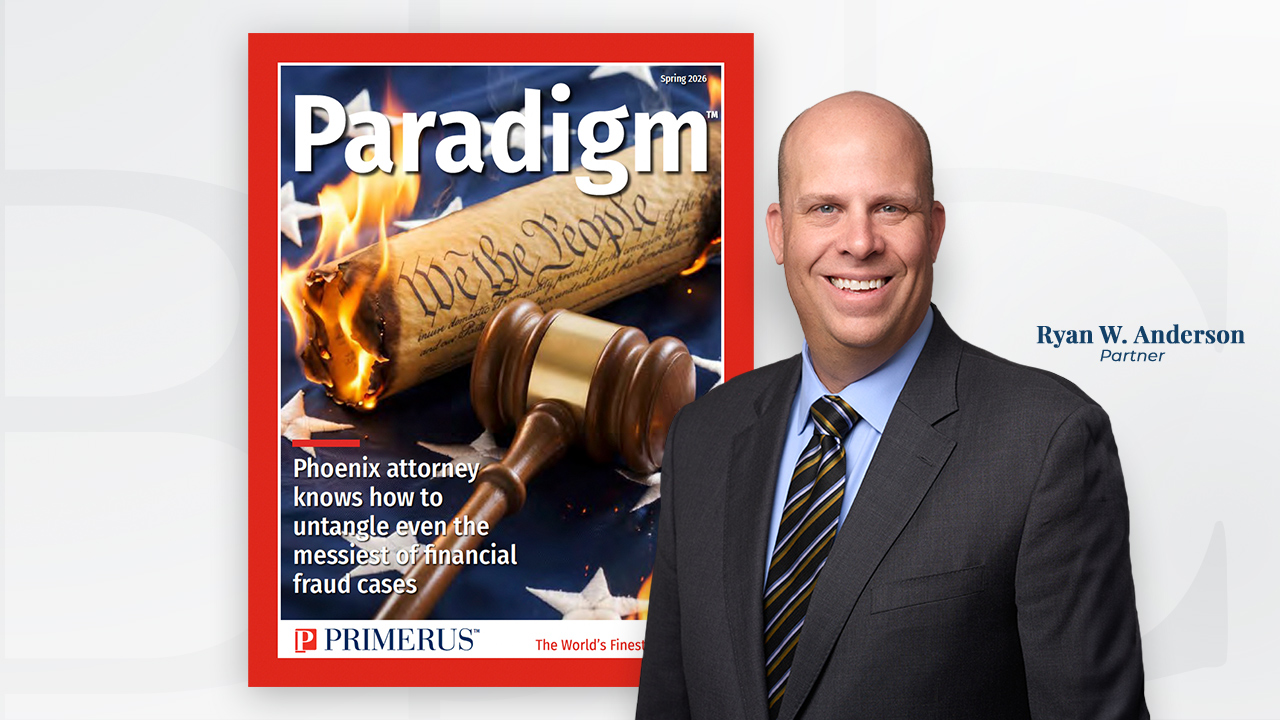
Originally published in Primerus Paradigm, Spring 2026.
By Brian Cox
As an Arizona attorney who has earned a top-shelf reputation in the field of receiverships, Ryan Anderson relishes opportunities to don a white hat and be the good guy.
For more than two decades, he has assisted clients who have been appointed receivers by the courts to shut down fraudulent operations and help victims recover a portion of their lost assets.
A receivership is a legal process in which a neutral third party – the receiver – is appointed by a court to take custody, control, and management of a business or organization. As an agent of the court, the receiver is assigned to stop harm, unwind damage, and return as much value as possible to those who have been wronged.
“The engagements that are complicated and challenging are the ones that I am most interested in. My preferred receivership engagements are when the government has placed something into a receivership because then I get to work with clients to unwind complicated issues,” says Anderson, a partner at Burch & Cracchiolo, P.A. in Phoenix. “I’m working for the defrauded victims and helping them recover money that they’d never have a chance to recover.”
The cases can vary widely. One month may involve dismantling a classic Securities and Exchange Commission Ponzi scheme. The next could involve liquidating the assets of a fraudulent company selling fake medications.
Some of Anderson’s most memorable cases read like crime novels. One recently concluded matter began with a suicide and a box of cash hidden in a clothes dryer. The case involved a hard-money lending business whose principal was deceived by a reality television star into lending hundreds of millions of dollars under false pretenses.
“I get a phone call from the Arizona Corporation Commission,” Anderson recalls, “And they say we have a case where we have a deceased bank president and a box of money. Inside the box were written instructions on how to launder the money.”
Working with forensic accountants and investigators, Anderson helped reconstruct a sprawling fraud involving fake property purchases, falsified documents, and exploitation of weaknesses in Arizona’s foreclosure statutes. The case culminated in a marathon deposition where the alleged fraudster was confronted with documents and recordings he did not know the receiver had uncovered – a moment that could have come out of a Perry Mason novel written by Erle Stanley Gardner.
“At the end of it, we had boxed him in. I knew I had him at that point,” Anderson says. “Months later, he was indicted, and he’s now serving a decade in prison for what he did.”
Over time, Anderson has built a reputation for handling high-profile receivership matters in collaboration with government agencies. The model itself has expanded well beyond financial fraud. In Arizona, state law allows education authorities to seek receiverships over failing or troubled school districts. Anderson has represented clients in those matters, as well as working with forensic examiners and fraud specialists appointed to decipher complex schemes.
Anderson encountered his first receivership case during his second year at Southwestern Law School in Los Angeles. That summer, he was a law clerk for a small law firm in Phoenix where he was tasked with doing more than research motions or draft memos. The firm had become involved in a series of state and federal receiverships and Anderson suddenly found himself entering fraudulent businesses alongside undercover police officers with guns drawn. The young law student found the work thrilling and marveled that a lawyer could be in this type of practice.
“I was hooked,” he says.
That same summer marked his first appearance in federal court when he accompanied a client to Tucson, Ariz. with the expectation of shuttering a fraudulent business once the order was filed in state court back in Phoenix. Instead, he was unexpectedly thrust before a federal judge hearing a case on the company to explain why a state-court receivership should take precedence. He wasn’t even wearing a suit.
That sense of immediacy and consequence has never faded for Anderson. He is invigorated by complicated situations that require sophisticated unraveling. Part of the field’s appeal is also philosophical. In a receivership, he does not represent a conventional client.
“You are an agent of the court,” he explains. “I get to tell the truth to everybody I interact with in a receivership. It’s the most refreshing thing.”
Every material decision is transparent and court-approved. Motions to sue, settle, or sell assets are laid out for judicial review. That neutrality, Anderson believes, is often misunderstood – even by lawyers who claim to practice in the space.
“There are a lot of people that put on their websites that they do receiverships,” he says. “But they don’t appreciate that their role is effectively as an officer of the court. Unfortunately, they are looking at it as if they’re a plaintiff or a defendant, and in the receiver position, you are not.”
The benefits of the receivership model, in Anderson’s view, are not merely ethical but economic. Compared to bankruptcy proceedings, receiverships can dramatically increase recoveries for victims. In bankruptcy, professional fees often consume large portions of the estate. In receiverships, creditor lawyers do not get paid from recovered funds.
“In recent receivership cases that I’ve closed,” Anderson says, “even though the case runs for a decade or more, we’re looking at recoveries of 60 to 70 cents on the dollar.”
He points to a striking historical comparison from the aftermath of the 2009-10 mortgage crash. Two nearly identical Arizona mortgage companies – Mortgages Limited and Landmark Capital Investment Company – collapsed under fraud. Mortgages Limited went through bankruptcy; Landmark entered receivership.
“The recovery for victims in Mortgage Limited was pennies on the dollar,” Anderson says. “A recovery for victims in Landmark was 70 cents on the dollar.”
For Anderson, that twin study remains a powerful illustration of why receiverships are often the superior tool for figuring out complex financial disasters.
Navigating the nuances of liquor licensing regulations has been a growing part of Anderson’s law practice.
“While I do a ton of bankruptcy work and represent bankruptcy trustees,” he says, “I do believe for a complicated financial problem, a receivership is the trusted model we all should use.”
Anderson’s ability to foresee how a case is likely to unfold has become the hallmark of his practice.
“I think clients would say my main skill is the ability to strategize how the case is going to work,” he says. “I am also not shy about being creative in this practice space. I think to solve complicated problems, you need to have some creativity on what to do.”
Parallel to his receivership work, Anderson has also built a significant practice in liquor licensing, which is why he sometimes describes his practice as a “unicorn.”
“The people that I work with in the receivership world have no clue that I have a huge liquor licensing practice,” he says. “And the liquor licensing practice people have no idea I’m over here doing these massive receivership cases.”
The duality appealed to him as a young lawyer. Liquor licensing provided a steady, predictable workflow – a hedge against the cyclical nature of receiverships, which tend to surge when economic conditions worsen.
“You don’t control when the government brings a case,” Anderson says. “And you don’t control how long those cases last.”
Today, Anderson leads what he describes as the largest liquor licensing practice in Arizona. He represents major national retailers including Safeway, Albertsons, Target, and Walmart, serving as agent on more than a thousand liquor licenses.
The work is deceptively complex. In Arizona, certain liquor licenses – such as the Series 9 license required for grocery stores – can cost up to $1 million USD, making them major corporate assets. Anderson advises clients not just on compliance, but on long-term strategic planning, especially amid consolidation in the grocery and retail sectors.
What he enjoys most, however, is the problem-solving aspect.
“When I started to do some work in that space, I was always trying to focus on how do we use the liquor licensing to do something different,” he says.
Arizona’s liquor laws, many drafted in the 1950s, were not designed for modern lifestyle developments, planned communities, or open-container entertainment districts. Anderson has been at the forefront of adapting those statutes to new realities, including licensing structures for homeowners’ associations and large shopping centers.
“That’s what I actually enjoy doing on the liquor side,” he says. “Sort of, the more complicated stuff.”
Outside the office, Anderson’s life centers around family. He is married to Dina L. Anderson, who recently retired after nearly 16 years as a federal bankruptcy trustee. They have two children: a daughter who’s a high school senior immersed in musical theater, and a son who’s a high school freshman with a burgeoning baseball card business that has drawn in Anderson, who himself is a lifelong Dodgers fan and avid sports enthusiast.
For all the scale and complexity of his work, Anderson remains invested in educating others. He regularly presents to government agencies, teaches CLEs for the Arizona Attorney General’s Office, and advises agencies on the use of receiverships.
Over the last two years, Anderson has seen both of his practice areas grow exponentially.
But that’s okay with him.
“It just keeps me really, really, really busy,” he says.